During this course, I have gained so much more experience and knowledge about myself and my work. My tutor has guided, encouraged and pushed me to achieve a practice that has grown out of curiosity, collaboration, and a willingness to change by the materials I work with. The past year has been a period of steady but significant evolution, both in how I approach making and how I understand myself in relation to the environment around me.
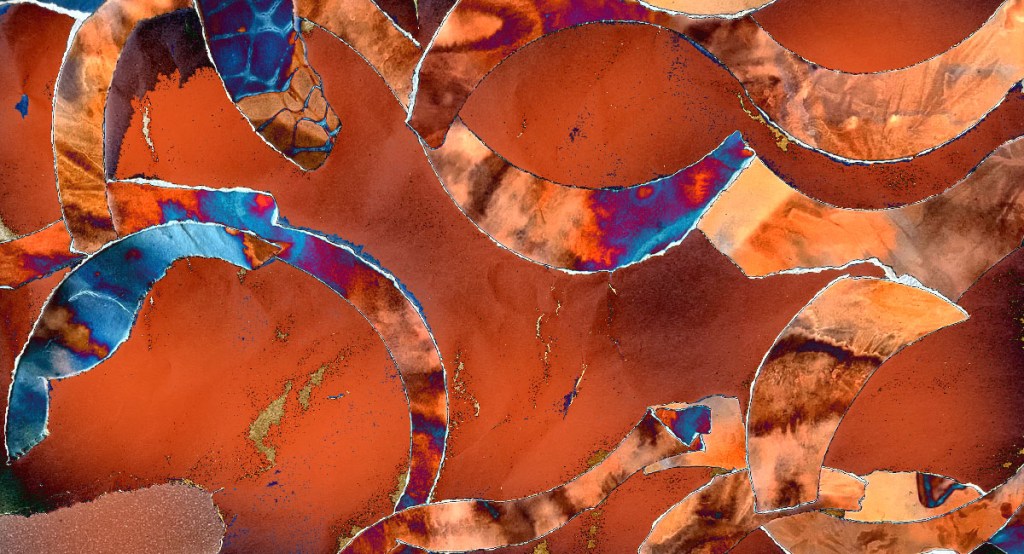
At the centre of my work lies a complex love/hate relationship with water, seeing it as a source of both beauty and a threat, and also capable of causing destruction and loss. Over the course of this unit, that relationship has developed into more than a theme, it has become a framework for my thinking and the development of my practice. By working with the river water directly, staining and shaping surfaces with it, I have encouraged the river to leave its own trace on the work. This shift from representing water to collaborating with it, has been one of the most transformative aspects of my artistic journey so far.
This journey has not been a solo one. I have always believed that creativity thrives in conversation, and I feel fortunate to be surrounded by colleagues and friends who not only share feedback but also bring their curiosity, doubts, and generosity to the table.
I have learnt that critique is most valuable when it feels like dialogue rather than judgment. For two of the projects this year, we were asked to seek peer feedback. I found this process revealing in unexpected ways, generous and always constructive encouraging me to re visit ideas and consider alternative approaches to my art.
Equally important have been the less formal interactions, gallery visits with peers to exhibitions such as Kiefer/Van Gogh at the Royal Academy and Electric Dreams at Tate Modern. Meeting in real life has cemented colleagues into hopefully friends, and maintaining those relationships for many years to come.
My project plan at the start of the unit was primarily interested in the relationship I have with water. Over time, I allowed the work to shift organically. I moved away from traditional mapping and instead explored alternative ways to record my interactions with the river and open water, through texture, and through processes that physically involved collaborating with found objects, both natural and man made, as well as physically using the river water within the work.
Two experiences in particular shaped my approach this year. The first was visiting the Anselm Kiefer exhibition at the RA. The monumental scale, the density of material, and the raw physical presence of his work left a lasting impression. It challenged me to think more boldly, to question whether I was playing too safe with my own materials, and to push toward greater physicality in my pieces.
The second was the guidance of my tutor, whose encouragement to “loosen up” helped me break away from my tendency toward precision and control. Her recommendations to research artists such as Emma Stibbon and Mark Dion encouraged me to see material not as a passive tool but as an active collaborator. From Stibbon I took the discipline of maintaining a sketchbook, both physical, using fineliner and pencil, and digitally, this has given me a continuous practice of observation and reflection which is so valuable. From Dion I learned the value of physically working directly with my environment, treating the river and open water not just as a subject but as a participant.
Experimentation has been central to my growth, remembering that I don’t need to have any urgency in reaching any conclusions. Learning and incorporating new techniques such as collagraphs and cyanotypes, processes I had not explored before. These opened up new possibilities for surface, texture, and colour, and their connection to water and sunlight gave them a natural resonance with my ongoing passion for the environment. Collagraphs, with their tactile qualities, have allowed me to evoke the natural textures and layering of the found objects, while the cyanotypes linked directly to the climate elements of light and water. All this has taught me to embrace unfamiliar methods as a process of experimentation.
Looking ahead, I sense that my work is beginning to shift outward, from my personal experience of water and flooding toward a wider environmental conversation. I am drawn to exploring water as a shared resource and as a force at the heart of climate change, rising sea levels, drought, and the fragility of our ecosystems. I want to retain my personal and emotional connection to water, but to let it intersect with broader environmental narratives and away from my personal experiences of flooding.
The cyanotypes, with their dialogue between sunlight, water and the found objects, feel like a progressive path to pursue further, along with the environment, and with the emotional questions that drive my art. I am enjoying the new and ongoing discoveries that I am continually reaching through the making of new work.
I end this unit aware that the journey of my practice is far from finished. I feel have just begun to articulate the next set of questions that will push me forward onto the next chapter. As an artist I feel more complete in my voice and in my practice.

 Viv King. Level 3. BA Fine Art