LO1. Examine your emerging practice through a considered body of self-directed work.
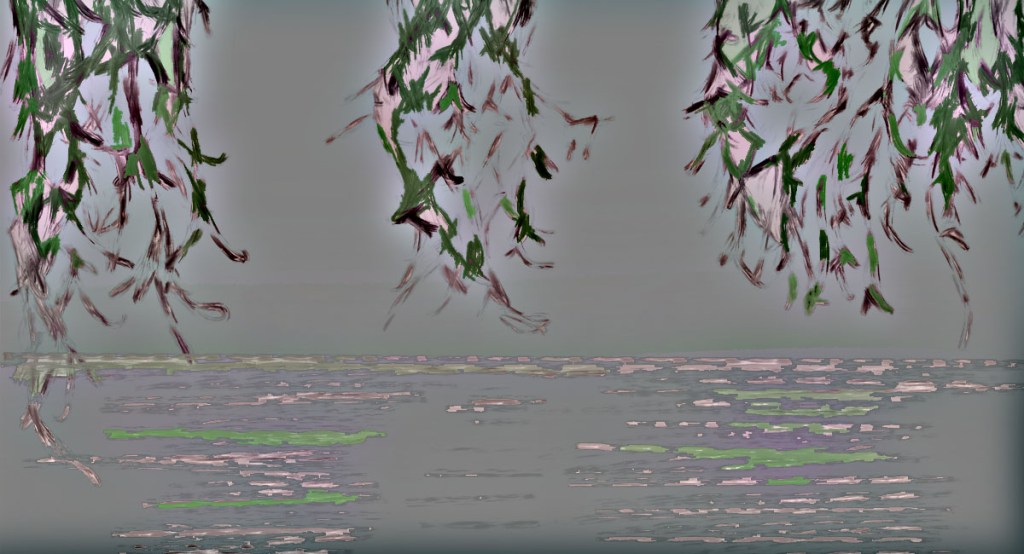
The procreate pieces are working well. When you hone in, show the fragmentation, the cracks and the patterns of shapes, then this is when it works as they emulate the floor of the river beds. Sometimes, you are too literal with drawing in the cones and other identifiable objects.
LO2. Apply relevant research methods and subject knowledge to test, inform, and develop your work.
Seeing work in the flesh by going to exhibitions is giving you first hand experience of the surface and the textures that can signify your overall themes. For example, seeing Kiefer’s work has given you ideas about the ‘physical presence’ of your work and how important that is. Think about the enormity of the river floods, is your work too quiet in comparison? Consider scale.
It’s a good idea to see the work as a ‘sculptural response’. The collographs and cyanotypes have very different characteristics. Cyanotypes showing the ‘flow’ and the collagraphs showing texture. The ripping and tearing is certainly more organic. However, putting the two methods together looks like too much and we lose some honest natural causes of deterioration and instead become too forced in the making process.
You are testing your work through various fine art methods, both hand-generated and digital. This shows a breadth of exploration.
LO3. Present informed connections between your research and practice interests.
The CR-
Possible titles- ‘Aftercare and the aftermath, a practice made and written with the open water’. ??- too specific
‘What does the river remember and what is lost and forgotten’? – how emotional do you want to be?
We decided on the ‘Aftercare and Aftermath of the floods. What is forgotten and what is lost?’- make sure this title is in your head as you write so it does not veer off into unnecessary topics.
Have a robust introduction where you outline your intentions, reasons for the subject and how you will unpack it.
You have made a good start by using factual evidence and this balances out the more emotional reactions of your love/hate relationship with the flooding.
It’s good for the reader to hear about your lived experiences so we can visualise it and have empathy. But what about the hate element? Can this come through by you being more critical with the council? The counter-argument?
A good way to introduce your practice of ecological balance. This theme can be extended. However, when you discuss your work it becomes a learning log entry where you are annotating.
Think more objectively about your practice. Give us an overview and a few snippets of a couple of pieces and how they relate to the flooding (which you have described well).
The main factor is to be more critical and this could be about ecological balance. To create an academic framework around this, expand on the practitioners who deal with the same theme. How do they evoke awareness, loss, beauty (the things you feel) into their work.
Combine the factual evidence, your practice, artists examples. At the moment it is a list (the flood factual information, your work, artists which seem like an after-thought)
It could be categorised (themed) paragraphs (sub-headings) e.g. the destruction, the aftermath,the emotions etc.
The conclusion needs to circle back to the title- so is it about the aftermath?
Contest, be inquisitive and critical more.
LO4. Articulate your creative ideas and critical thinking using suitable communication methods.
You are being more critical of your work now that there are many experiments to choose from. Make sure you are being inquisitive and asking questions of whether the work is satisfying your intentions of the overall themes so far.
My notes and reflections
The Keifer exhibition for me was a real inspiration and a turning point to appreciate how much physical presence should be present in my work. Taking this change in direction was purely because of how I felt after seeing his work. The collage was too big, A0, and way too busy, combining so many textures didn’t work on a large scale, however when cropped the work looked better, the layering and textures were much more defined.
I should separate the cyanotypes and the collagraphs. The cyanotypes are about the flow of the water and the collagraphs are about the texture. As two different art forms they carry different characteristics. The tearing and ripping is good practice for me, I should be mindful of being organic and not overthinking.
The procreate sketches are something I should continue with to support my ongoing practice. Try not to be too representational, the physical presence comes through within the surface textures.
I need to continue with my experimental work, and push forward with the cyanotypes. Project 10 isn’t a final piece but somewhere to start the next unit.
The CR needs to be more refined and organised as a piece of critical work. Fortunately the bulk of the work is done, however it reads a list rather than a review. Introduce the factual information, my lived experiences and combine this with the artists.
I need to be mindful of my audience, make sure the work is clear and reads through well.
Action points
- Consider scale, longer formats (to have more of a flow and not be constricted by borders- wallpaper?)
- Does your work have enough ‘physical presence’ to emulate the river beds and floods? Some questions to think about moving forward.
- The last two larger images at the button of your P9 blogpost work very well. Because they are cropped, the textures have more of a chance to breathe and be present. The larger piece becomes too overwhelming.
- Make amendments and rearrange the CR- the meat is there but bit of a list at the minute.

 Viv King. Level 3. BA Fine Art